
10 Small Living Room Ideas That Feel Warm All Year
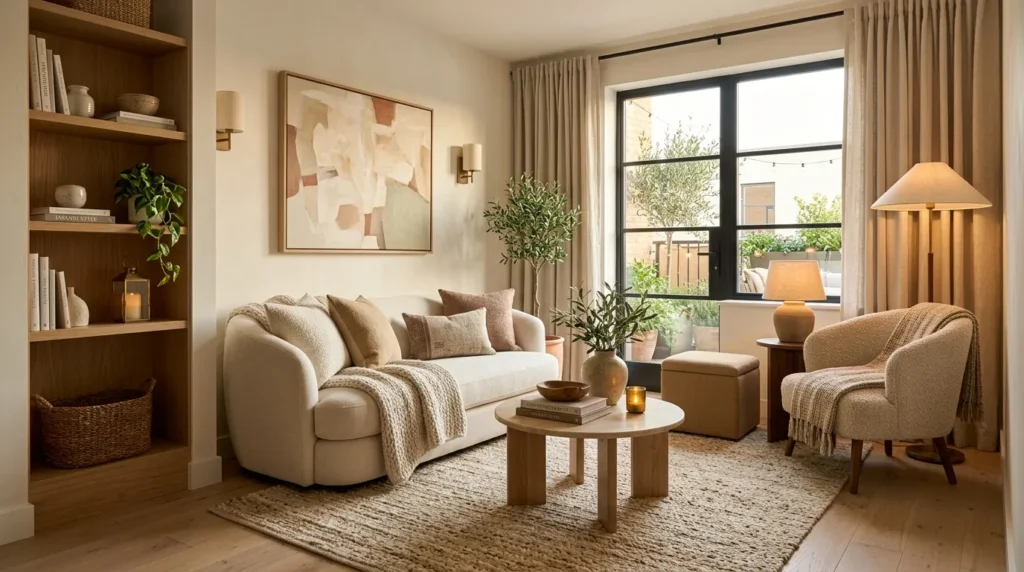
A small living room can be one of the coziest spaces in a home when it is designed around comfort instead of simply trying to make the room look bigger.
The challenge is finding the right balance. Too much furniture makes a compact room feel crowded, while too little can make it feel unfinished and surprisingly cold. The goal is to create a space where every piece has a purpose while still leaving enough breathing room for movement.
Warmth also means more than adding a few throw blankets.
Color, lighting, texture, furniture placement, natural materials, window treatments, and even the way accessories are grouped all influence how inviting a room feels.
I’ve noticed that the most comfortable small living rooms usually don’t depend on one dramatic decorating trick. Instead, several subtle choices work together. A soft rug grounds the seating area. Warm lighting creates atmosphere after sunset. Curtains soften the windows. Wood accents add natural character. And a carefully chosen sofa gives the room somewhere comfortable to gather.
The best part is that these ideas can work throughout the year.
You don’t need to completely redecorate for every season. Instead, build a warm foundation with timeless materials and colors, then make small seasonal changes through pillows, throws, flowers, artwork, and accessories.
Whether you’re decorating a small apartment, townhouse, rental, condo, or compact family room, these ideas can help you create a living room that feels comfortable without becoming cluttered.
Think of the room as a collection of layers.
Start with the layout, add comfortable furniture, introduce texture, soften the lighting, and finish with a few personal details.
The result should feel welcoming in January, fresh in spring, relaxed during summer, and cozy again when fall arrives.
Table of Contents
1. Warm Neutral Colors
Build the room around comforting shades that remain versatile throughout the year.
2. Soft Layered Textures
Combine fabrics and tactile materials to make the room feel comfortable and inviting.
3. Compact Comfortable Sofa
Choose seating that provides genuine comfort without overwhelming the floor plan.
4. Cozy Area Rug
Use a rug to visually anchor the seating area and add warmth underfoot.
5. Layered Ambient Lighting
Combine several light sources to create a softer atmosphere after dark.
6. Natural Wood Accents
Introduce wood to add organic warmth and visual character.
7. Full-Length Curtains
Use fabric at the windows to soften the room and create a finished appearance.
8. Curved Furniture Shapes
Bring softness into a compact layout with rounded edges and flowing silhouettes.
9. Personal Decor Layers
Use meaningful objects and artwork to make the room feel lived-in.
10. Flexible Seasonal Styling
Create a timeless foundation that can be refreshed throughout the year.
1. Warm Neutral Colors
Quick Benefits
- Creates an inviting foundation
- Works in every season
- Makes small rooms feel cohesive
- Allows textures to stand out
- Simplifies future decorating
Why It Works
Color has a major effect on how a small living room feels.
Cool whites and stark grays can sometimes make a compact space feel visually harder, particularly when there isn’t much natural light.
Warm neutrals create a softer backdrop.
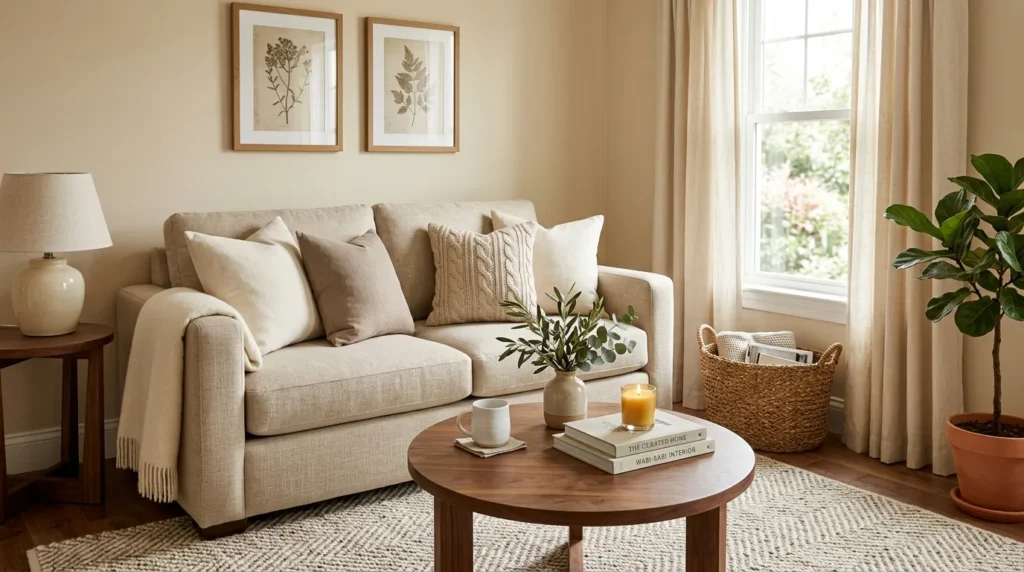
Think cream, ivory, warm beige, mushroom, taupe, soft camel, and gentle earthy tones. These shades reflect light while adding subtle warmth.
You don’t need to paint every surface beige.
The goal is to create a connected palette where the walls, sofa, rug, curtains, and accessories relate naturally.
A warm foundation also makes seasonal decorating easier because almost any muted accent color can be introduced without fighting the existing scheme.
How To Style It
Choose one primary neutral for the walls or largest surfaces.
Then add one or two complementary tones through furniture and textiles.
For example, warm white walls can pair beautifully with a beige sofa, oatmeal rug, walnut accents, and cream curtains.
If you prefer a little more contrast, add charcoal or deep brown through lamps, frames, or occasional furniture.
For color, consider muted sage, dusty blue, terracotta, or olive.
Avoid introducing too many unrelated accent shades.
Repeating the same two or three colors throughout the room creates the kind of visual continuity that makes a compact space feel thoughtfully designed.
2. Soft Layered Textures
Quick Benefits
- Adds visual warmth
- Makes simple furniture more inviting
- Creates depth
- Improves comfort
- Keeps neutral rooms from looking flat
Why It Works
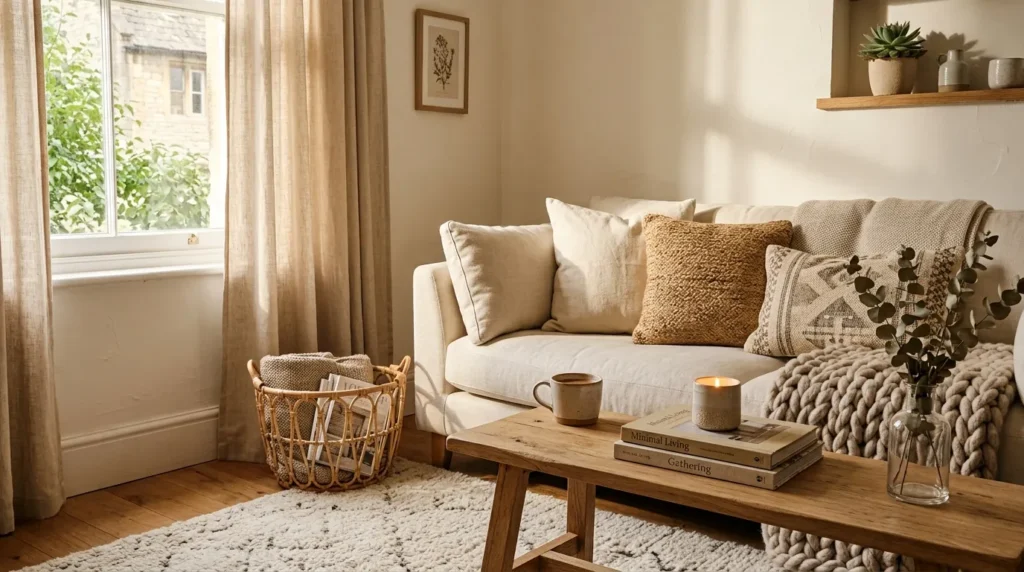
A small living room can feel warm even when the color palette is extremely simple.
The secret is texture.
Imagine a cream sofa against a plain wall. It might look clean, but without texture it can also feel somewhat flat.
Now add a woven rug, linen curtains, a chunky throw, cotton cushions, a wooden table, and a ceramic lamp.
The colors may remain almost identical, but the room suddenly feels richer.
Texture gives the eye something to explore without requiring additional colors or decorative objects.
How To Style It
Start with the largest textile, usually the rug.
Then add cushions in different fabrics.
Mix smooth cotton with linen, boucle, woven fabric, or subtle knits.
Place one comfortable throw over the sofa rather than covering every seat.
Add a woven basket beside the sofa for blankets or magazines.
Ceramic accessories can provide another tactile layer.
The key is variation without excess.
If the sofa is heavily textured, choose smoother pillows.
If the rug has a strong pattern, keep the curtains and cushions relatively quiet.
A small room benefits from texture that feels intentional rather than visually noisy.
3. Compact Comfortable Sofa
Quick Benefits
- Maximizes usable seating
- Establishes the room’s focal point
- Keeps circulation comfortable
- Supports everyday relaxation
- Makes the layout more functional
Why It Works
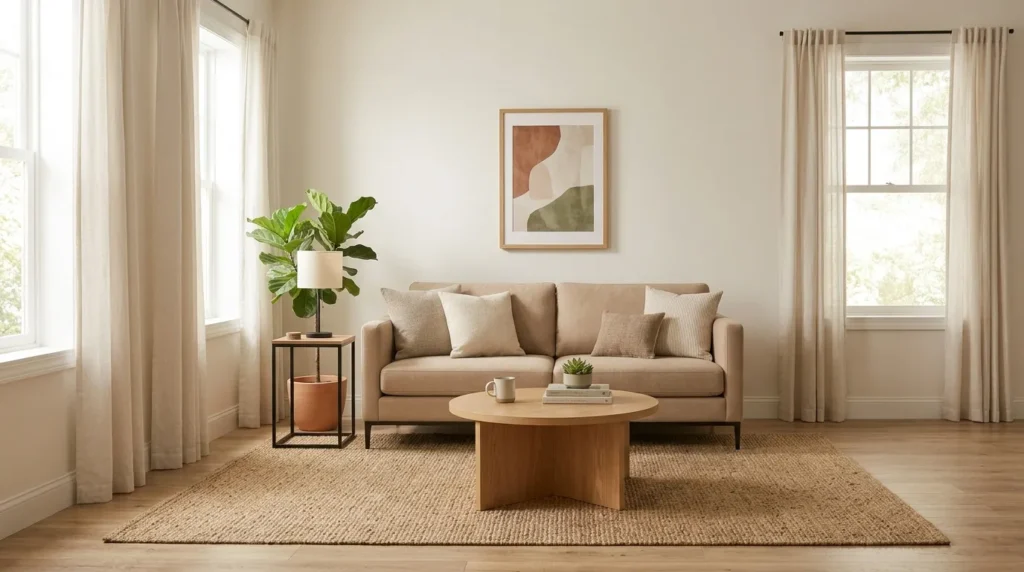
The sofa is often the largest piece of furniture in a living room, so its size and shape have an enormous effect on the space.
A common mistake is choosing a sofa based only on how much seating it offers.
In a small room, proportion matters just as much.
A sofa that is too deep can consume valuable floor space, while an oversized chaise can make movement awkward.
That doesn’t mean you need an uncomfortable miniature sofa.
A compact but properly proportioned design can provide plenty of comfort while leaving room for a coffee table, side table, or additional chair.
How To Style It
Measure the room before shopping.
Pay attention to the sofa’s total width, depth, arm width, and overall height.
A sofa with narrower arms can sometimes provide more usable seating without increasing the overall footprint.
Consider a loveseat, apartment-size sofa, or streamlined three-seat sofa.
Choose upholstery in a warm neutral if you want maximum flexibility.
Position the sofa so it doesn’t block the primary walkway.
If there is room, add one small accent chair or ottoman rather than another large seating piece.
Keep the furniture arrangement focused around conversation rather than pushing every piece against the walls.
4. Cozy Area Rug
Quick Benefits
- Defines the seating area
- Adds warmth underfoot
- Introduces texture
- Makes furniture feel connected
- Softens hard flooring
Why It Works
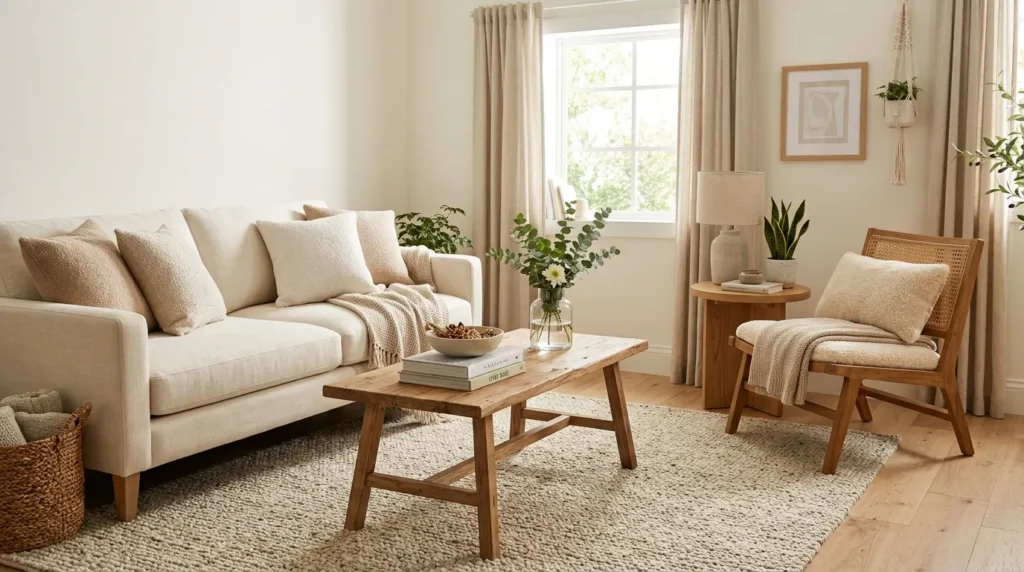
An area rug can visually transform a small living room.
Without one, furniture can appear disconnected, particularly when the room has hardwood, tile, laminate, or another hard surface.
A rug creates a visual zone.
It tells the eye that the sofa, coffee table, and chairs belong together.
It also adds physical warmth, which is especially noticeable during colder months.
The trick is choosing a size that is large enough to connect the furniture without overwhelming the room.
How To Style It
Whenever possible, allow at least the front legs of the main seating pieces to sit on the rug.
If space is limited, position the rug under the coffee table and extend it toward the sofa.
Choose a warm neutral for maximum year-round versatility.
Cream, oatmeal, taupe, natural beige, and muted geometric patterns are easy to work with.
For a more relaxed room, consider a textured flatweave or woven-style rug.
For extra softness, look for a comfortable pile that suits your cleaning needs.
Avoid choosing a tiny rug simply because the room is small.
A very small rug can make the furniture arrangement feel fragmented rather than cozy.
5. Layered Ambient Lighting
Quick Benefits
- Creates a warm evening atmosphere
- Reduces harsh shadows
- Makes the room feel more sophisticated
- Highlights textures
- Supports different activities
Why It Works
Lighting is one of the easiest ways to change the mood of a living room.
A single ceiling fixture can provide useful general illumination, but it rarely creates the cozy feeling people want in the evening.
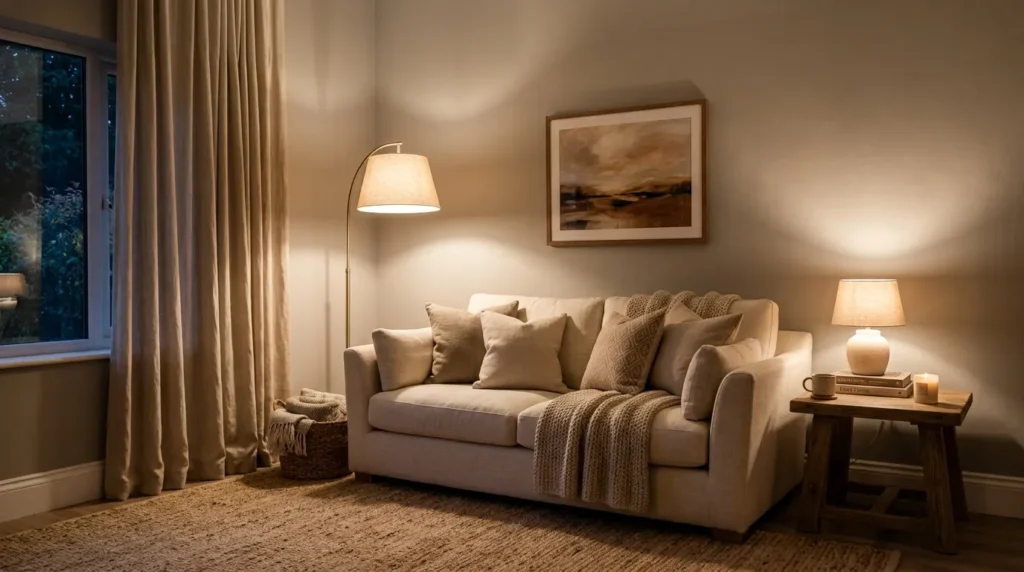
Layered lighting gives you control.
A floor lamp can illuminate a reading corner.
A table lamp can create a soft glow beside the sofa.
A ceiling fixture can remain available when you need brighter general light.
This creates depth instead of illuminating the room uniformly.
How To Style It
Aim for at least two or three useful light sources if the room allows.
Place a floor lamp beside the sofa or chair.
Use a table lamp on a console or side table.
Keep the overhead fixture for practical tasks.
Choose warm light appropriate for the fixtures and activities.
If you have artwork or architectural details worth highlighting, use suitable accent lighting rather than flooding the entire room.
Avoid placing every lamp at exactly the same height.
Different levels of light create a more relaxed atmosphere.
And remember that natural daylight is part of the lighting design too.
Keep windows as open as practical during the day.
6. Natural Wood Accents
Quick Benefits
- Adds organic warmth
- Works with many color palettes
- Creates visual contrast
- Balances soft fabrics
- Gives the room character
Why It Works
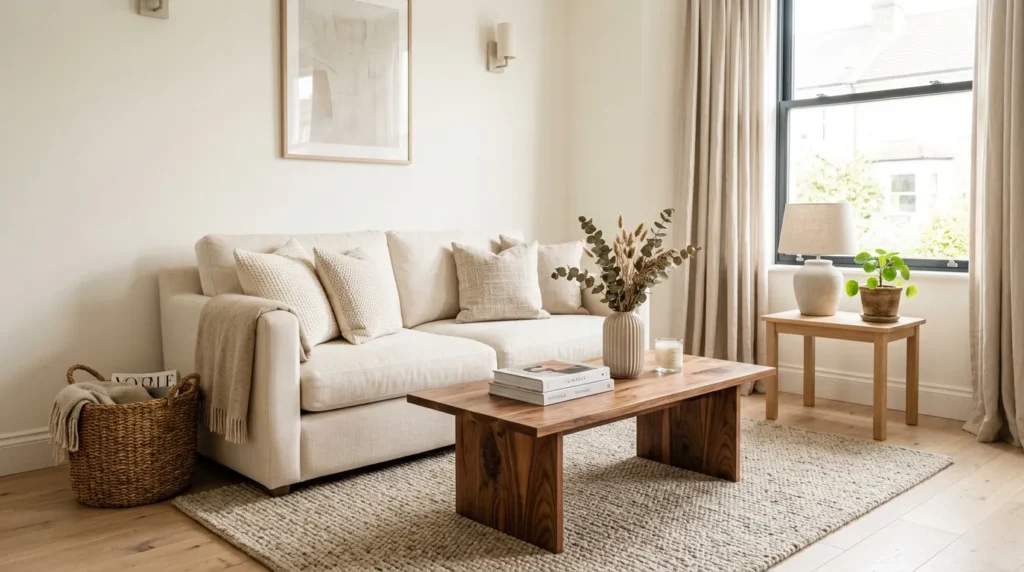
Wood is particularly effective in compact living rooms because it brings warmth without requiring much visual space.
A small oak coffee table, walnut side table, wood-framed artwork, or woven wooden accent can prevent a neutral room from feeling overly sterile.
Natural materials also complement soft fabrics.
The contrast between hard wood and plush upholstery makes the room feel more layered.
You don’t need every piece of furniture to be wooden.
One or two thoughtfully selected accents are often enough.
How To Style It
Choose a wood tone that complements the existing room.
Light oak creates a casual, airy appearance.
Walnut adds richer contrast.
Medium natural wood can bridge warm and cool colors.
Repeat the wood tone in at least one other small detail when possible.
For example, pair a walnut coffee table with a wood picture frame.
Add a woven basket or natural-fiber accessory for another organic layer.
Avoid mixing too many dramatically different wood tones in a very small room unless you’re intentionally creating an eclectic look.
7. Full-Length Curtains
Quick Benefits
- Softens windows
- Adds fabric and texture
- Creates vertical emphasis
- Makes the room feel finished
- Helps control sunlight and privacy
Why It Works
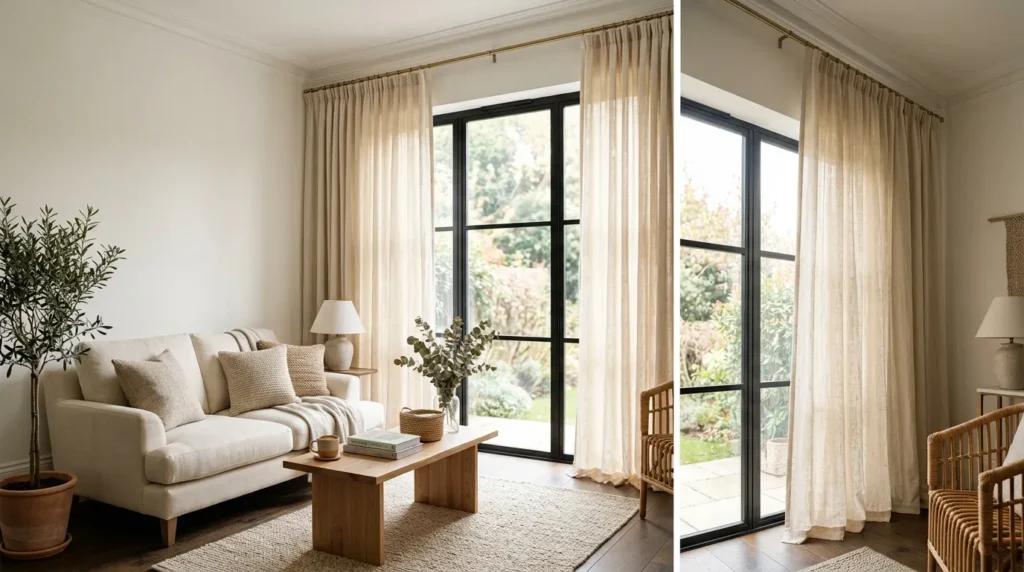
Curtains can make a small living room feel considerably more finished.
Bare windows can leave a room feeling visually hard, while fabric introduces softness.
Full-length panels also create vertical lines that can draw attention upward.
This can be particularly useful when the room has modest ceiling height.
Curtains also have a practical role.
They help control glare, privacy, and sunlight while contributing to the overall color palette.
How To Style It
Choose curtains that complement the main upholstery rather than competing with it.
Warm white, ivory, oatmeal, beige, and soft natural linen tones are versatile.
When the architecture allows, mount the curtain rod somewhat higher and wider than the window frame.
Let the panels extend toward the floor.
Avoid extremely short curtains that stop awkwardly above the floor.
If strong sunlight is an issue, consider layering decorative panels with appropriate shades or blinds.
Keep the fabric visually simple if your rug or cushions already contain pattern.
The goal is softness and continuity.
8. Curved Furniture Shapes
Quick Benefits
- Softens the room visually
- Improves movement around furniture
- Adds personality
- Balances rectangular architecture
- Creates a more relaxed appearance
Why It Works
Small living rooms often contain many straight lines.
Walls, windows, sofas, cabinets, rugs, and tables can all create rectangles.
Adding one curved element breaks up that repetition.
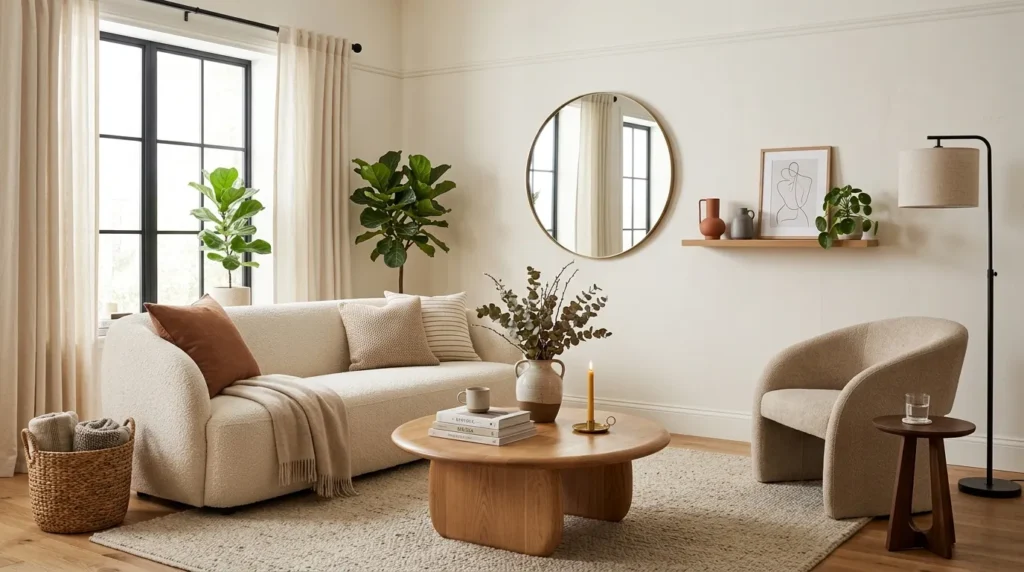
A round coffee table can improve movement around the seating area.
A curved accent chair can soften a corner.
A rounded lamp or circular mirror can introduce another gentle shape.
These details may seem small, but they can significantly change the visual rhythm of the room.
How To Style It
Start with one curved element.
A round or oval coffee table is often the easiest choice because it can make circulation feel more comfortable.
Pair it with a rectangular sofa for contrast.
You could also use a round side table, curved floor lamp, arched mirror, or rounded ottoman.
Don’t turn every piece into a curve.
The strongest effect comes from contrast between straight and soft forms.
Keep the materials coordinated.
For example, an oak round coffee table can work beautifully with a cream sofa, woven rug, and black metal lamp.
9. Personal Decor Layers
Quick Benefits
- Makes the room feel lived-in
- Adds personality
- Creates visual interest
- Prevents a staged appearance
- Encourages emotional connection
Why It Works
A living room should feel like someone’s home, not a furniture showroom.
Personal details are what give the room its identity.
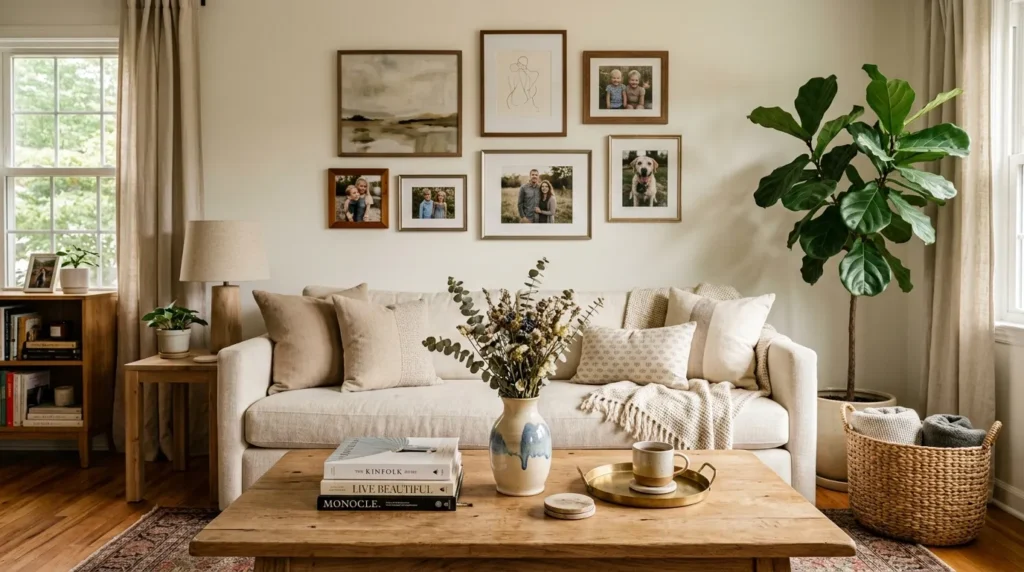
Family photographs, collected artwork, travel souvenirs, books, handmade ceramics, and meaningful objects can all add warmth.
The trick is editing.
A small living room doesn’t have enough visual space for every object you’ve collected over the years.
Choose the pieces that actually mean something to you.
The result will feel more authentic and usually more interesting.
How To Style It
Create small groupings rather than spreading individual objects randomly around the room.
Stack a few favorite books on the coffee table.
Place a ceramic vase beside them.
Display one or two framed photographs on a shelf.
Hang artwork at an appropriate height rather than filling every wall.
Use baskets to hide practical items such as throws, toys, or magazines.
Leave some empty space.
Personal styling works best when the meaningful pieces have room to be noticed.
10. Flexible Seasonal Styling
Quick Benefits
- Keeps the room fresh
- Avoids expensive seasonal redecorating
- Maintains a consistent foundation
- Makes small updates easy
- Supports year-round comfort
Why It Works
One of the smartest ways to create an all-year warm living room is to make the permanent elements timeless.
You don’t need a completely different room for spring, summer, fall, and winter.
Instead, use your sofa, rug, curtains, furniture, and main artwork as the permanent foundation.
Then adjust smaller elements.
This saves money and prevents the room from becoming overloaded with seasonal decorations.
How To Style It
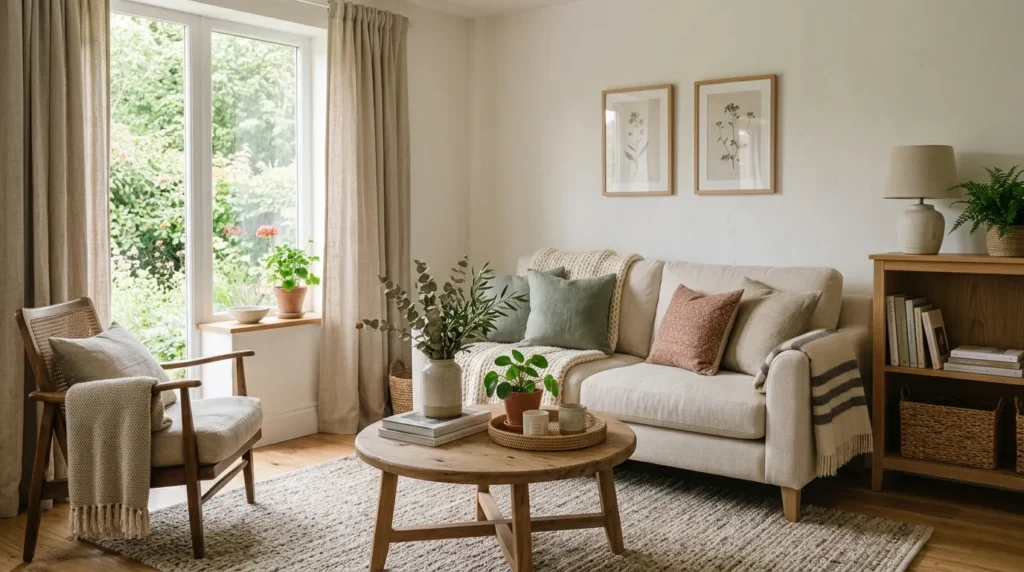
For spring, introduce fresh greenery, lighter pillows, and soft botanical accents.
During summer, use breathable linen textures, lighter throws, and natural woven accessories.
In fall, add warm rust, caramel, olive, or terracotta accents.
During winter, bring in chunky textures, deeper neutral tones, candles, and plush blankets.
Keep your major furniture pieces consistent.
This approach makes seasonal decorating feel effortless.
You are changing the atmosphere rather than redesigning the entire room.
How To Make A Small Living Room Feel Warm Without Making It Cluttered
Warmth and clutter are not the same thing.
You can have a cozy room with plenty of texture while keeping surfaces relatively clear.
Start by separating your belongings into three groups:
Useful: Things you regularly need.
Beautiful: Objects that genuinely contribute to the room.
Sentimental: Pieces that have personal meaning.
Everything else should be reconsidered.
Use closed storage where possible.
Baskets are especially useful for blankets, children’s toys, remotes, magazines, and other everyday items.
Keep the coffee table relatively simple.
One tray, a few books, a small vase, or a candle can be enough.
The room should have softness without becoming visually crowded.
Best Warm Colors For A Small Living Room
If you want a palette that feels comfortable throughout the year, consider:
- Warm white
- Cream
- Ivory
- Beige
- Oatmeal
- Taupe
- Mushroom
- Camel
- Soft brown
- Muted sage
- Dusty blue
- Terracotta
You can use darker shades sparingly for contrast.
For example, a cream sofa can look beautiful with walnut furniture and charcoal accents.
The goal is balance.
If everything is pale, introduce darker natural materials.
If the room already has dark furniture, lighter walls and textiles can keep the space from feeling heavy.
How To Arrange Furniture In A Small Living Room
A functional arrangement starts with circulation.
Measure the room before moving large furniture.
Identify the main entrance and the routes people naturally take.
Then place the sofa first.
Build the rest of the arrangement around it.
A coffee table should be close enough to reach comfortably without blocking movement.
Side tables should be positioned where drinks, books, and lamps are actually useful.
Don’t automatically push every piece against a wall.
Sometimes floating the sofa slightly away from a wall creates a stronger conversation area.
If the room is extremely compact, choose fewer pieces with better proportions rather than trying to recreate a large living room in miniature.
FAQ
How can I make a small living room feel cozy?
Use a warm color palette, comfortable seating, a properly sized area rug, layered lighting, soft curtains, natural wood, and a few meaningful accessories. The key is layering rather than adding clutter. Keep circulation clear and choose furniture that fits the room proportionally.
What colors make a small living room feel warmer?
Warm whites, creams, beige, taupe, oatmeal, camel, soft brown, muted sage, and terracotta can all create a comfortable atmosphere. Use several related tones rather than relying on one shade. Repeating colors across furniture, textiles, artwork, and accessories creates visual continuity.
How do I make a small living room cozy without clutter?
Focus on texture instead of quantity. Add one comfortable rug, several coordinated cushions, a throw, curtains, and natural materials. Use baskets or closed storage to hide practical items. Keep decorative surfaces edited so the room still has visual breathing space.
Should a small living room have a rug?
An area rug can be extremely helpful because it visually connects the seating area and adds warmth underfoot. Choose a size that allows at least the front legs of major seating pieces to sit on it when possible. A very small rug can make the furniture arrangement look fragmented.
What type of sofa is best for a small living room?
Look for a sofa with proportions suited to the room, including an appropriate width and depth. Slimmer arms can maximize usable seating. Apartment-size sofas, loveseats, and streamlined three-seat sofas can work well. Always measure the room and the sofa before purchasing.
How can I make my living room feel warm at night?
Layer your lighting. Use a floor lamp, table lamp, or other suitable secondary light source alongside the main ceiling fixture. Choose warm light appropriate for your fixtures. Soft lamps positioned at different heights create a more inviting atmosphere than relying on one bright overhead light.
How can I decorate a small living room for every season?
Keep the major elements timeless and change smaller accessories. Use lighter textiles and greenery in spring and summer, then introduce rust, olive, caramel, deeper neutrals, and heavier textures during fall and winter. This approach keeps the room cohesive while allowing the atmosphere to change naturally.
Conclusion
A small living room can feel warm all year when comfort, proportion, texture, and lighting work together.
You don’t need a huge sectional, dozens of decorative accessories, or a complete renovation.
Start with a warm neutral palette.
Choose furniture that fits the room instead of fighting it.
Anchor the seating area with a comfortable rug.
Add layers of soft textiles and natural wood.
Use curtains to soften the windows and warm lighting to create atmosphere after dark.
Then add the details that make the room yours.
A favorite piece of artwork, a stack of books, a handmade vase, family photographs, or a well-loved throw can make a room feel genuinely lived in.
The most important thing is to resist the temptation to fill every empty corner.
A small room needs breathing space.
Let the furniture have room around it. Keep surfaces edited. Choose accessories intentionally. Repeat a few colors and materials so everything feels connected.
Then let the room evolve with the seasons.
A few lighter textiles can refresh it in spring. Natural woven accents can make summer feel relaxed. Terracotta and olive can bring autumn warmth. Plush blankets and deeper neutral tones can make winter evenings feel especially inviting.
The goal isn’t simply to create a room that looks cozy in photographs.
It’s to create a space where you genuinely want to sit, relax, talk, read, watch a movie, or enjoy a quiet evening at home.
That’s what makes a small living room feel warm all year.
Related Articles
- How to Decorate a Living Room with Cozy Furniture
- 10 Ideas: How to Decorate a Living Room Like a Professional Stylist
- 10 Small Living Room Ideas for a More Functional Space
- 10 Cozy Home Decor Ideas for a Warm and Inviting Space
- 10 Modern Living Room Ideas for Small Spaces