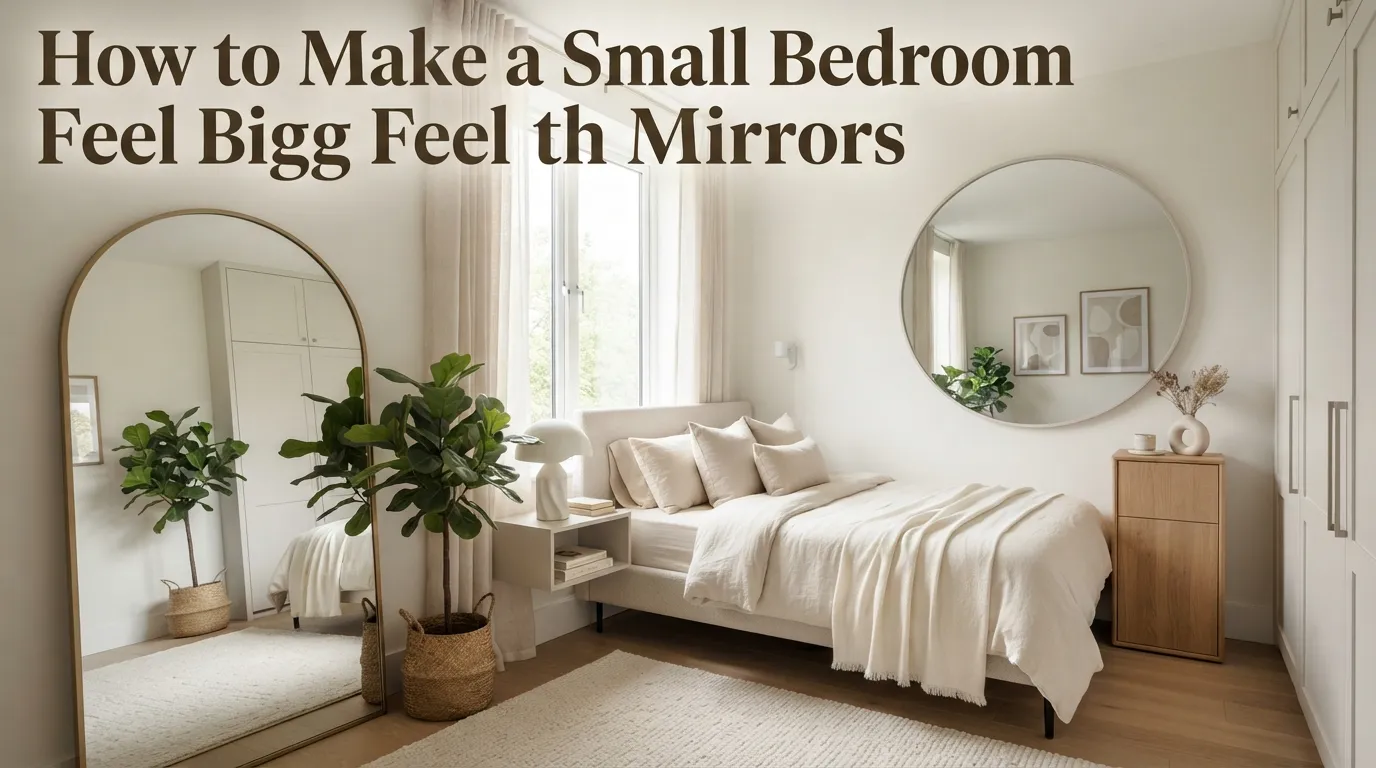
10 Ideas on How to Make a Small Bedroom Feel Bigger with Mirrors
A small bedroom can feel surprisingly spacious when you use mirrors strategically.
The trick isn’t simply adding a large mirror and hoping the room looks bigger. Placement, scale, lighting, reflection, and the surrounding furniture all influence how much visual space a mirror actually creates.
When positioned thoughtfully, a mirror can reflect natural light, extend a sightline, make a narrow wall feel wider, and visually double an attractive part of the room. It can also become a beautiful decorative feature rather than looking like a purely functional object.
This is especially useful in compact bedrooms where adding more furniture isn’t practical.
I’ve noticed that mirrors work best in small bedrooms when they are treated as part of the overall layout rather than as an afterthought. A mirror facing a bright window can bounce daylight deeper into the room. A tall mirror beside a closet can emphasize ceiling height. A pair of narrow mirrors can create symmetry without requiring much wall space.
You also don’t need to cover the walls with reflective surfaces.
One carefully selected mirror can make more difference than several poorly placed ones.
The following ideas focus on practical ways to use mirrors while keeping the bedroom comfortable, stylish, and uncluttered. You’ll find options for renters, homeowners, modern bedrooms, cozy spaces, minimalist interiors, and rooms where floor space is extremely limited.
The goal isn’t to make the bedroom look artificially huge.
It’s to make the existing space feel lighter, more open, and easier to live in.
Table of Contents
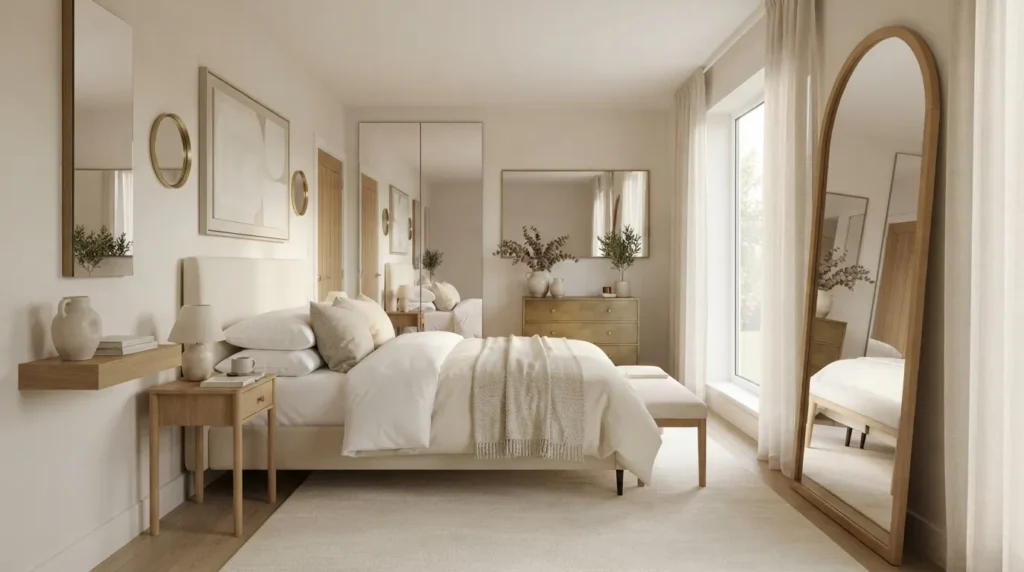
1. Opposite Window Reflection
Use a mirror to reflect daylight deeper into the bedroom.
2. Full-Length Wall Mirror
Create a taller visual proportion with a vertical mirror.
3. Mirrored Closet Doors
Combine storage and reflection in one surface.
4. Narrow Wall Mirror
Use slim proportions to open up tight walls.
5. Pair Of Bedside Mirrors
Create symmetry while visually expanding the room.
6. Mirror Behind Nightstand
Add depth to a small bedside area.
7. Large Leaning Mirror
Create an airy full-length focal point.
8. Mirrored Gallery Wall
Layer several small reflections into one arrangement.
9. Reflective Furniture Details
Use subtle mirrored surfaces without overwhelming the room.
10. Ceiling-Height Mirror
Emphasize vertical space with a dramatic placement.
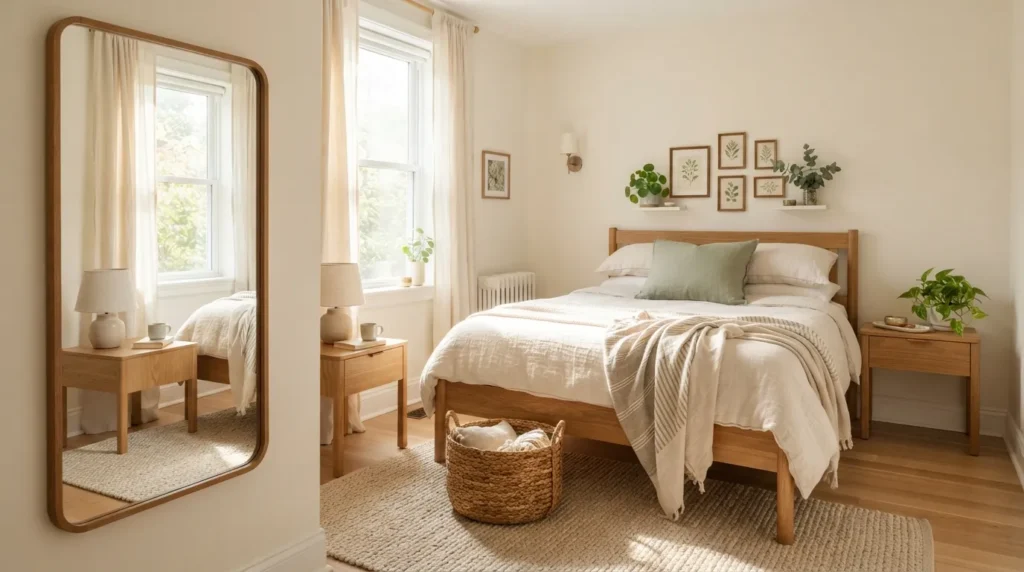
1. Opposite Window Reflection
Quick Benefits
- Reflects natural daylight
- Makes the room feel brighter
- Creates visual depth
- Works especially well in dark bedrooms
- Can make a window feel larger
Why It Works
Natural light is one of the easiest ways to make a small room feel more open.
When a mirror is positioned to reflect a window, it can bounce light into areas that would otherwise remain darker. The reflection also gives the eye another view of the room, creating the impression of greater visual depth.
The effect is strongest when the reflected view is attractive and uncluttered.
A mirror facing a bright window can make the room feel more luminous, while a mirror reflecting a messy corner may simply make the clutter more noticeable.
How To Style It
Look at the room from the bed and doorway before choosing the mirror location.
If possible, position a medium-to-large mirror where it catches daylight from the window.
Keep the area being reflected relatively tidy.
A simple wood or thin metal frame can complement the bedroom without competing with the view.
For a warm neutral bedroom, try a natural oak frame, aged brass, or soft black depending on the existing furniture.
Avoid positioning the mirror where it creates uncomfortable glare.
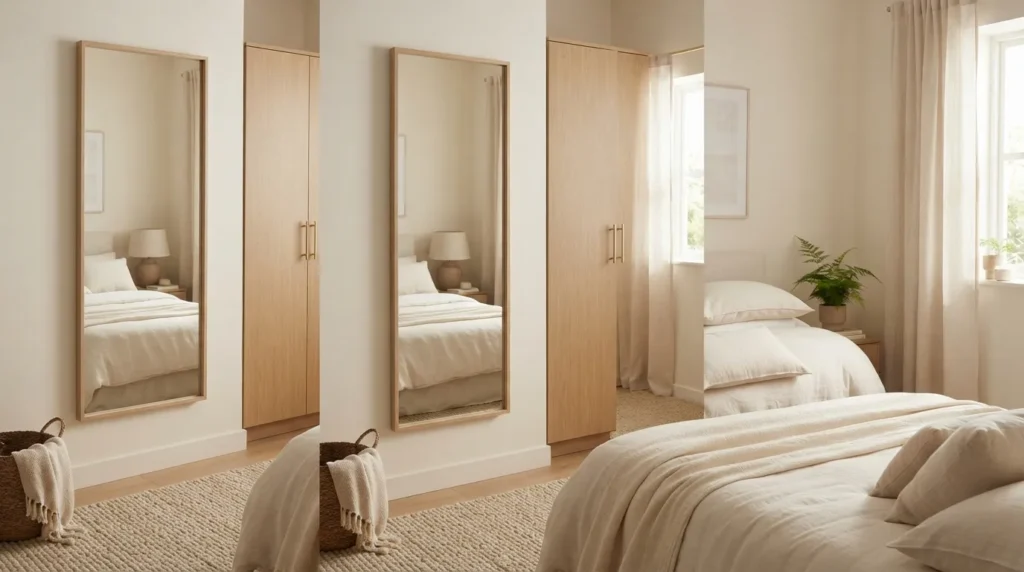
2. Full-Length Wall Mirror
Quick Benefits
- Emphasizes vertical space
- Provides useful dressing functionality
- Makes a wall feel taller
- Creates a strong focal point
- Works without adding furniture
Why It Works
A tall mirror naturally draws the eye upward.
In a bedroom with a low ceiling or limited floor area, that vertical emphasis can make the room feel more spacious.
A full-length mirror is also highly practical because it combines everyday functionality with visual expansion.
Rather than using a small decorative mirror that only reflects part of the room, a full-height design can create a longer sightline.
How To Style It
Choose the tallest mirror that fits comfortably within the available wall.
A slim black frame works well in modern rooms.
A natural wood frame creates a warmer organic feeling.
For minimalist bedrooms, a frameless mirror can blend more quietly into the wall.
Place it near the closet or dressing area when possible.
Keep surrounding furniture relatively low and streamlined so the mirror remains visually effective.
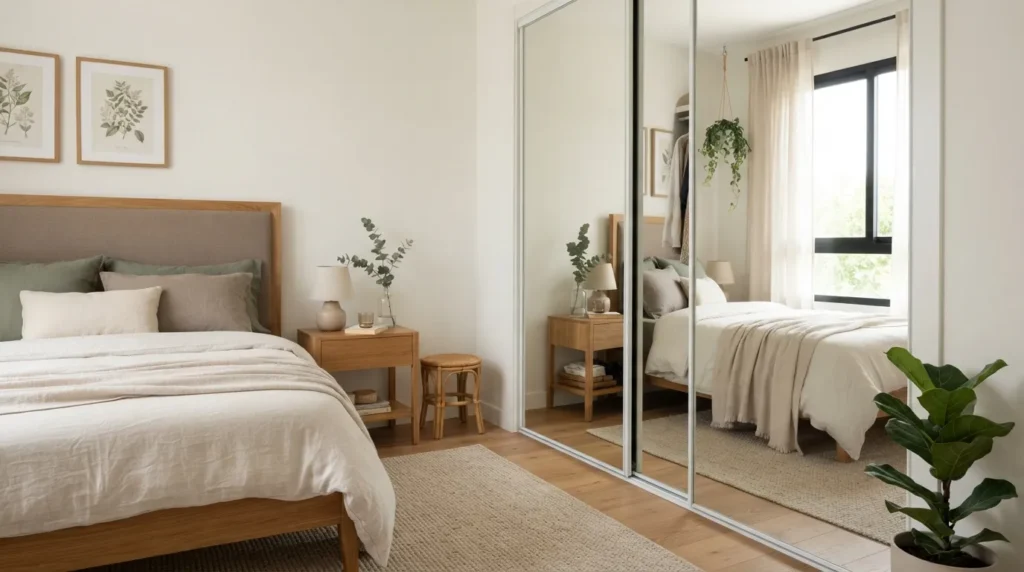
3. Mirrored Closet Doors
Quick Benefits
- Combines storage and reflection
- Saves wall space
- Makes wardrobes visually lighter
- Creates a larger-looking sightline
- Works well in compact bedrooms
Why It Works
Closets often occupy a large amount of wall space in small bedrooms.
Mirrored closet doors can make that large storage surface visually recede by reflecting the room instead of presenting a solid block of cabinetry.
This can be especially helpful when the closet sits opposite a window or bright wall.
The reflection adds another layer to the room while preserving the storage function.
How To Style It
If you’re replacing closet doors, consider full-height mirrored panels with simple frames.
For existing wardrobes, removable mirror panels or appropriately mounted decorative mirrors may provide a similar effect depending on the furniture and wall construction.
Keep the reflected side of the room organized.
If the mirror faces an open clothing rack or crowded shelf, the visual effect may become busier rather than more spacious.
Use coordinated bedding and furniture colors to create a cleaner reflection.
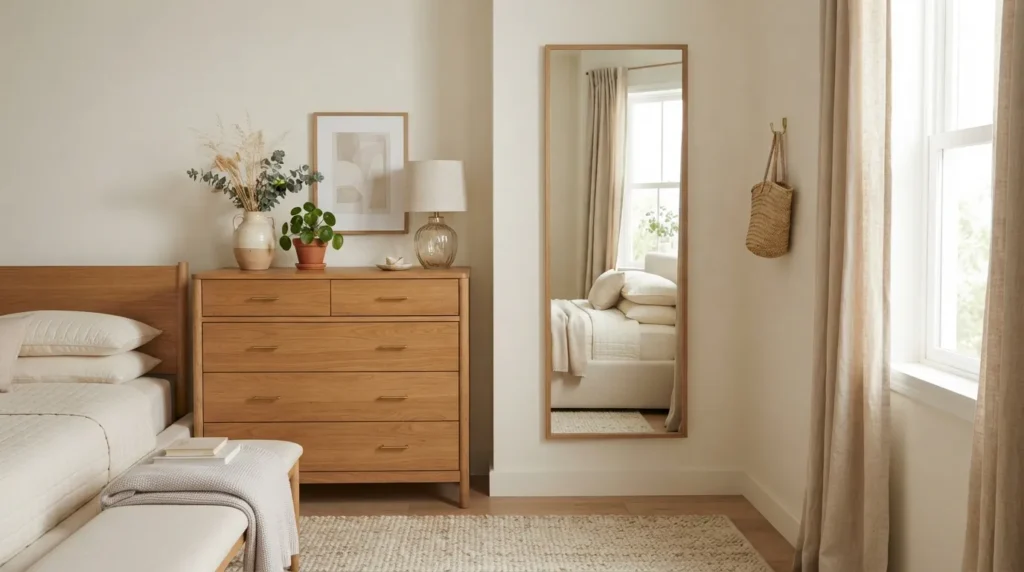
4. Narrow Wall Mirror
Quick Benefits
- Fits tight spaces
- Adds vertical dimension
- Works beside furniture
- Uses otherwise awkward wall areas
- Creates subtle visual depth
Why It Works
Not every small bedroom has room for a wide mirror.
A narrow vertical mirror can work beautifully in the spaces beside a closet, between windows, or next to a dresser.
Because the mirror is tall rather than wide, it emphasizes height without requiring much wall width.
This is particularly useful when the room already contains substantial furniture.
How To Style It
Choose a narrow mirror approximately 10–20 inches wide if that suits the available space.
Look for a simple frame that complements the room.
Place it beside a dresser, near the closet, or on an otherwise empty vertical section of wall.
Avoid crowding it with several other wall decorations.
One strong vertical element can look more spacious than a collection of small pieces.
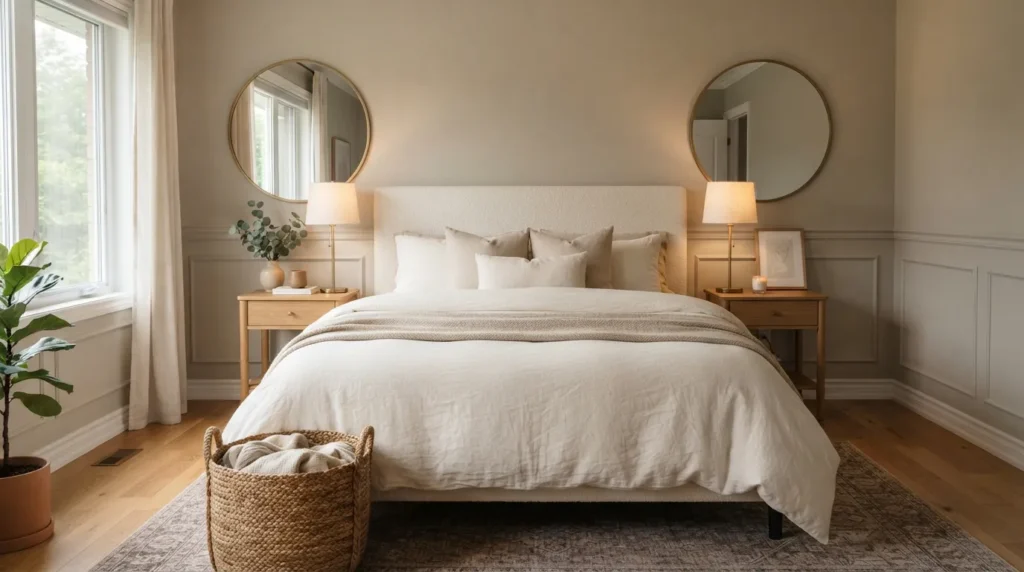
5. Pair Of Bedside Mirrors
Quick Benefits
- Creates symmetry
- Adds visual depth
- Reflects light from both sides
- Makes the bed area feel balanced
- Works with small nightstands
Why It Works
Symmetry can make a compact bedroom feel more intentional.
Two mirrors positioned above or beside matching nightstands create a balanced visual frame around the bed.
The reflections can also make the wall appear more layered without requiring large artwork or bulky shelving.
This approach works particularly well when the bed is the natural focal point of the room.
How To Style It
Choose two mirrors with similar proportions.
Round mirrors soften a modern bedroom with straight furniture.
Rectangular mirrors reinforce a clean, structured aesthetic.
Hang them at a consistent height.
If the nightstands are small, keep the mirrors proportionate rather than oversized.
Pair them with matching or coordinated lamps to create a cohesive composition.
6. Mirror Behind Nightstand
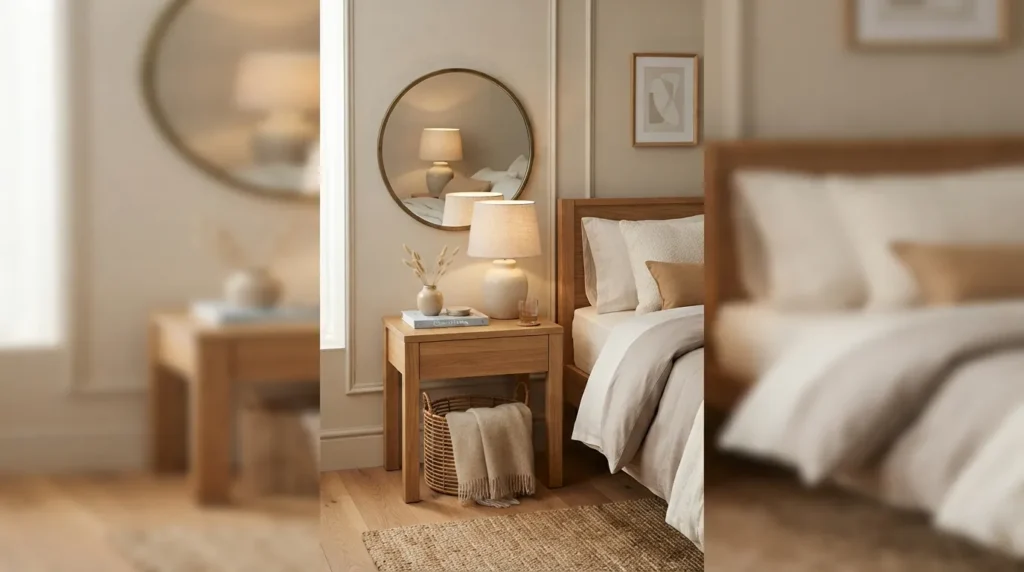
Quick Benefits
- Creates depth behind furniture
- Reflects light around the bed
- Adds a decorative focal point
- Works in narrow spaces
- Can replace traditional artwork
Why It Works
The wall behind the nightstand is often underused.
A mirror placed there can create a subtle sense of depth while reflecting light from a nearby lamp or window.
It also provides a useful alternative to artwork if you’re trying to keep the room visually light.
The key is scale.
A mirror that’s too small may look disconnected, while one that’s too large can overwhelm a compact bedside area.
How To Style It
Choose a mirror slightly narrower than the nightstand.
A round shape works especially well above a small square or rectangular table.
Place a simple lamp in front or beside it, leaving enough reflective surface visible.
Keep the nightstand relatively uncluttered.
A lamp, small tray, and one decorative item are usually enough.
7. Large Leaning Mirror
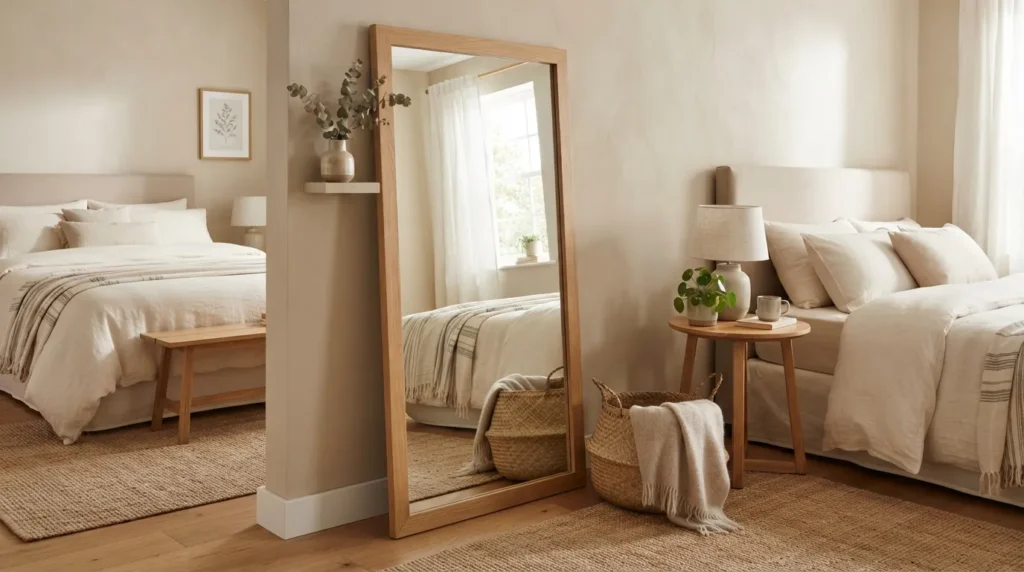
Quick Benefits
- Adds height without wall mounting
- Creates a relaxed aesthetic
- Provides full-body reflection
- Can be moved later
- Works well in rental bedrooms
Why It Works
A large leaning mirror can make a small bedroom feel taller while adding a relaxed, slightly more casual look.
It’s also useful for renters who don’t want to drill into walls.
Because the mirror extends vertically from the floor, it creates a strong visual line and can reflect a substantial portion of the bedroom.
However, safety matters.
A large mirror should be appropriately secured according to the manufacturer’s instructions, particularly in homes with children or pets.
How To Style It
Choose a simple full-length frame in wood, black, brass, or another finish already used in the room.
Lean it against a suitable wall where it doesn’t block circulation.
Position it so it reflects a bright area or attractive part of the room.
Avoid placing it opposite a cluttered storage area.
A nearby woven basket or simple plant can soften the composition without making it busy.
8. Mirrored Gallery Wall
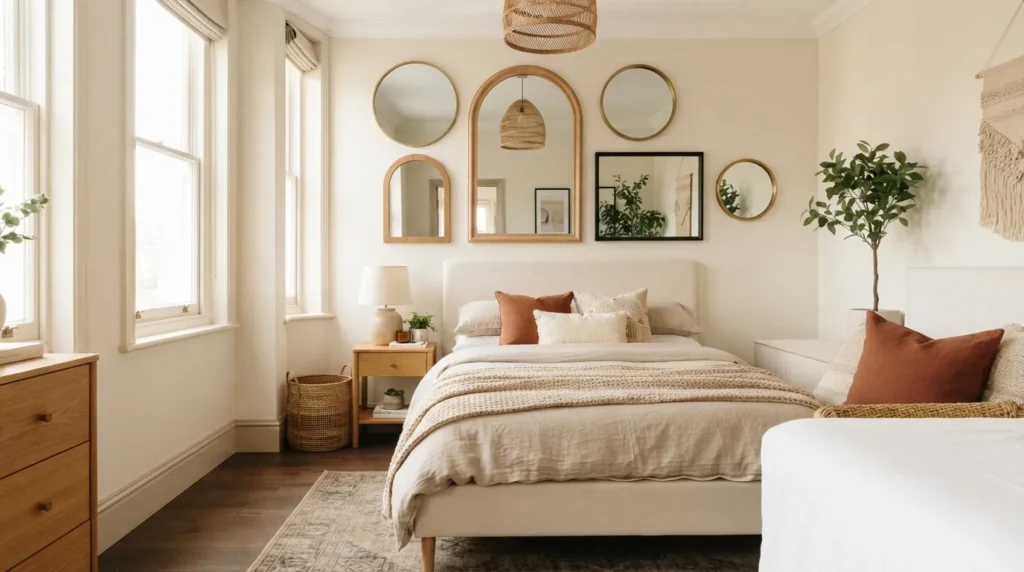
Quick Benefits
- Adds personality
- Creates multiple reflective points
- Uses small wall spaces
- Works with eclectic decor
- Can become a statement feature
Why It Works
A collection of small mirrors can create visual interest without requiring one enormous reflective surface.
Different shapes and frames can create a gallery effect, while the individual reflections add small pockets of light and depth.
This works especially well on a narrow wall that feels too small for large furniture.
The important thing is to keep the composition controlled.
How To Style It
Choose three to seven mirrors depending on the wall size.
Mix circles, arches, and simple rectangles for an eclectic arrangement.
Alternatively, use similar frames for a more sophisticated appearance.
Lay the mirrors on the floor first to experiment with spacing.
Keep enough negative space between pieces so the arrangement doesn’t look crowded.
A warm brass, natural wood, and antique-style combination can create an especially elegant bedroom feature.
9. Reflective Furniture Details
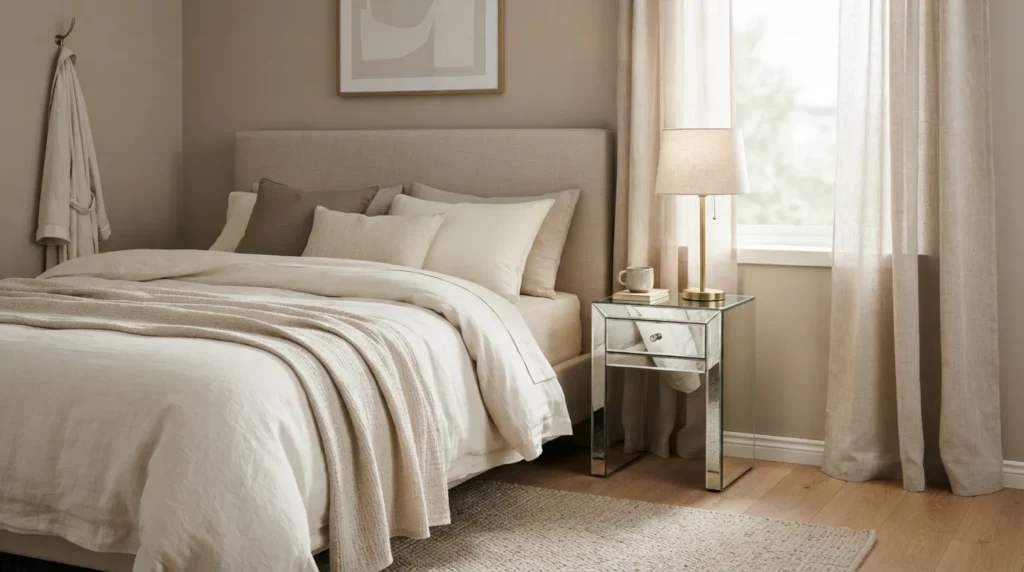
Quick Benefits
- Adds subtle reflection
- Keeps the bedroom sophisticated
- Doesn’t require large wall space
- Can brighten darker corners
- Works with modern furniture
Why It Works
You don’t always need a wall mirror to benefit from reflective surfaces.
A nightstand with a mirrored panel, a dresser with subtle glass details, or furniture featuring polished metal can reflect small amounts of light throughout the room.
This approach is useful when you want the spacious feeling of reflection without making mirrors a major visual feature.
How To Style It
Choose one reflective furniture piece.
A small mirrored nightstand can work particularly well beside an upholstered bed.
Alternatively, use brushed brass handles, polished metal lamp bases, or glass-topped furniture.
Balance reflective surfaces with matte materials such as linen, wood, wool, and ceramic.
Too many shiny surfaces can make a small bedroom feel visually busy.
The goal is subtle light reflection rather than a highly reflective room.
10. Ceiling-Height Mirror
Quick Benefits
- Emphasizes vertical proportions
- Creates a dramatic focal point
- Reflects more of the room
- Makes walls feel taller
- Works especially well in modern spaces
Why It Works
When a mirror extends high on the wall, the eye naturally follows its vertical line.
This can make a compact bedroom feel taller and more architectural.
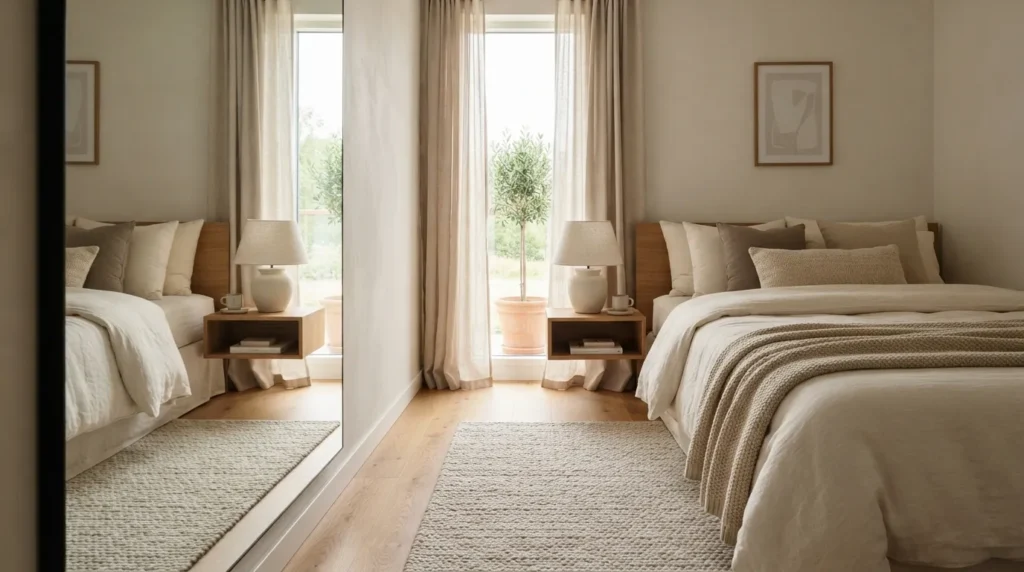
A floor-to-ceiling mirror can also reflect a larger portion of the room, increasing the sense of visual depth.
This is a stronger design statement than a small decorative mirror, so it works best when the rest of the room is relatively restrained.
How To Style It
Use a large vertical mirror on one strategic wall.
Keep the surrounding decor simple.
A frameless design can make the mirror blend more seamlessly into the room.
For a more decorative effect, choose a slim frame that coordinates with the bed or lighting fixtures.
Before installation, carefully consider what the mirror will reflect from different viewing angles.
A beautiful reflection can become one of the room’s strongest features.
How To Choose The Right Mirror Size
Mirror size matters more than many people realize.
A tiny mirror on a large empty wall can look insignificant.
A massive mirror squeezed between furniture can make the room feel crowded.
Start by measuring the wall and nearby furniture.
For a mirror above a nightstand, consider the width of the nightstand.
For a full-length mirror, prioritize height and safe placement.
For a large leaning mirror, make sure there is enough clearance around it for comfortable movement.
As a general design principle, larger mirrors often create stronger visual impact, but the correct size depends on the room’s proportions.
Use painter’s tape to mark the approximate dimensions on the wall before purchasing or installing a mirror. This simple step can help you visualize the final scale.
Where Not To Place Mirrors In A Small Bedroom
Mirror placement should be intentional.
Avoid placing a mirror where it reflects an area you don’t want visually repeated.
For example, if it faces a cluttered open closet, the reflection doubles that visual clutter.
Also consider glare.
A mirror directly facing a strong artificial light source can create uncomfortable reflections at night.
Think about privacy and comfort as well.
A mirror facing the bed is a personal design choice. Some people enjoy the reflective effect, while others prefer mirrors positioned toward a wall, closet, or window instead.
The best location is ultimately the one that improves the room without making it feel visually distracting.
How To Make Mirrors Look More Expensive
The frame can dramatically change the overall appearance.
For a warm bedroom, natural wood creates an organic feeling.
For a modern room, a slim black frame can provide crisp contrast.
Brushed brass adds subtle warmth and sophistication.
A frameless mirror creates a quieter minimalist appearance.
Try to repeat the mirror’s finish somewhere else in the room.
For example, a brass-framed mirror can coordinate with brass lamp details.
A wood-framed mirror can relate to the nightstand.
This repetition creates cohesion without requiring everything to match.
Mirror And Lighting Combinations That Work
Mirrors are most effective when they have something attractive to reflect.
Try pairing them with:
- Natural window light
- Soft bedside lamps
- Warm wall sconces
- A light-colored rug
- Cream bedding
- Natural wood furniture
- A small plant
- Neutral artwork
A mirror reflecting a bright window can help spread daylight.
A mirror reflecting a warm lamp can create a soft evening glow.
The surrounding design matters just as much as the mirror itself.
FAQ
Do mirrors really make a small bedroom look bigger?
Yes, mirrors can create the perception of greater visual space by reflecting light and portions of the room. The effect depends heavily on placement. A mirror reflecting a bright window or open area is generally more effective than one reflecting clutter or a dark corner.
Where should I put a mirror in a small bedroom?
Good locations include opposite or near a window, beside a closet, above a nightstand, on a narrow wall, or as a full-length mirror near a dressing area. Choose a location that reflects something attractive and doesn’t interfere with circulation or create uncomfortable glare.
Is a full-length mirror good for a small bedroom?
A full-length mirror can be particularly useful because it combines everyday functionality with vertical visual expansion. A tall mirror emphasizes height and can make a narrow wall feel more substantial without requiring additional furniture.
Should a bedroom mirror face the bed?
There is no universal design rule requiring or prohibiting this. It’s a personal preference. If you like the reflection, it can work well. If you find it distracting, position the mirror toward a window, wall, closet, or another attractive area instead.
What color mirror frame makes a room look bigger?
A frameless mirror or thin frame usually creates the least visual weight. Light wood, warm white, and subtle metallic frames can also work well. Dark frames can be beautiful but create stronger contrast, so they should coordinate with other elements in the room.
Can I use multiple mirrors in a small bedroom?
Yes, but restraint is important. Two coordinated mirrors or a small gallery arrangement can create depth and personality. Too many reflective surfaces may make the bedroom feel visually busy, particularly when they reflect different parts of the room.
How can renters use mirrors without damaging walls?
Large leaning mirrors, over-the-door mirrors, and appropriately rated removable mounting systems can provide renter-friendly options. Always check the manufacturer’s installation and weight requirements and make sure large mirrors are safely secured where necessary.
Conclusion
Mirrors can be one of the smartest decorative tools for a small bedroom because they provide both beauty and function.
The right mirror can reflect daylight, create depth, emphasize ceiling height, and make an otherwise awkward wall feel purposeful.
But the secret isn’t simply choosing the biggest mirror you can find.
Think about what the mirror will reflect.
Place it where it can capture natural light or an attractive part of the room. Use tall mirrors to emphasize vertical space. Try mirrored closet doors when storage takes up a large wall. Use a pair of bedside mirrors when symmetry would improve the layout.
And don’t forget the frame.
Natural wood, slim black metal, warm brass, and frameless designs can each create a completely different atmosphere.
Before installing anything, step back and consider the room from several angles.
A mirror should make the bedroom feel more open, not simply add another object to the wall.
Start with one strategic placement.
Once you see how reflection changes the room, you’ll have a much better idea of whether you need another mirror.
In a compact bedroom, thoughtful placement usually matters more than quantity.
With the right combination of reflection, light, proportion, and uncluttered styling, even a modest bedroom can feel brighter, taller, and much more inviting.
Related Articles
- 10 Ideas on How to Make a Small Bedroom Look Expensive
- How to Make a Small Bedroom Feel More Functional
- How to Organize a Small Bedroom with Hidden Storage
- 10 Cozy Aesthetic Bedroom Ideas You’ll Love
- 10 Modern Aesthetic Bedroom Ideas for Adults